I’m privileged to announce I’ve been asked to be a featured guest on The Literary Round Table podcast for a special series of conversation entitled “A House United: Understanding America and Each Other.”

I’m privileged to announce I’ve been asked to be a featured guest on The Literary Round Table podcast for a special series of conversation entitled “A House United: Understanding America and Each Other.”

Civil War Union soldiers recuperate at Carver Hospital, Washington D.C,. September 1864
Post-traumatic stress disorder has become an increasingly difficult challenge for the nation in the wake of three controversial and unpopular wars; Korea, Vietnam and Iraq. What soldiers thought they were fighting for and what they learned when they got overseas was often jarringly out of sync. Worse, the life they came back to was unrecognizable and adjusting to peacetime life was impossible. They have never come home.
Is it possible that a nation can also suffer violent, catastrophic and ultimately unhealed trauma that mirror the symptoms of personal PTSD: denial of an agony by refusing to talk about it; inability to grieve for the loss suffered; and concealing residual and shame-inducing bitterness?
I believe the Civil War and Reconstruction are the cornerstones of our national PTSD. To those generations that came after the war, too much history has been written to celebrate the glory of victory, or worse, the nobility of a lost cause whose legacy, slavery, is so heinous that its consequences are barely being accounted for two and a half centuries later –not in our teaching of history or in our national discourse. Not enough has been written about what it will take to bridge the divisions that the war and Reconstruction revealed and which now face us with rising urgency every day.
Perhaps in learning how to better treat our wounded veterans’ PTSD, we might also learn how to heal the heartbreak and loss that are eating at our collective soul. This is the first of several posts that will explore what it will take to foster national healing.

The Berlin Opera House as it looked in 1936, the year the author’s mother performed at it
It isn’t often you get to ask advice of your 96-year old mother about your own stage fright. But when I was speaking on my book tour (never having written a book or spoken publicly before), I was embarrassed that I would sweat profusely. That only added to my fear, convinced everyone noticed and was thinking, ’what’s his problem?’ I turned to someone with great experience – my mother.
Sono Osato danced with the Ballets Russes de Monte Carlo, the original company of American Ballet Theater as well as the Broadway shows ONE TOUCH OF VENUS and ON THE TOWN (as the original Miss Turnstiles). I mentioned my stage fright and asked her when was the most nervous she’d ever been and what she did about it. My mother didn’t miss a beat.
“It was at the Berlin Opera House in 1936. The Colonel (de Basil, manager of the company) had informed us that Himmler, Goering and Goebbels would be in the audience that night. I am sure I was not the only girl who prayed she would not accidentally look one of those men in the eye during the performance and have them take that as a signal.”
“Of what? That they liked the man?”
“Of course. I was terrified they might come backstage.”
“Ooh. What did you do?”
“The technique was to focus your eyes on a specific spot, whether in the theater or on a person. The stage lights will reflect back a little on the audience, so faces are visible. I realized I had to put my eyes somewhere safe during the performance. I chose the mezzanine façade. My eyes never met a Nazi there.
“So, dear, it’s best to focus on a spot, whether a thing or a person, to make a connection to the ‘out there’. That way you get out of your fear, out of your own way. Once you do that, somehow you’re not nervous anymore.” She made it sound so simple.
Luckily, my audiences weren’t Nazis, but Civil War buffs, students and American soldiers. Nevertheless, her advice worked.
Merci, maman.
I’ve written and spoken at some length about writing this book over 15 years. One would think that over that time, I would have a pretty clear sense of what the book is about. Think again.
I was invited to give a talk at the Civil War Trust Annual Conference in Richmond last month. The Civil War is by far the most written about period in our history and the Trust and its 60,000+ members work to preserve both the legacy and the actual ground the war was fought on. It was a big deal for me to be invited to speak at and participate in this event with historians whose work I’ve read and who’ve spent their whole lives writing and lecturing on this topic. Just to up the ante a bit more, I was told just before my talk that because the historical novel has not been presented before in this setting, I was the first author to ever read aloud his work – lecture being the traditional format. No pressure…
During my talk, I chose to read the regimental reunion scene that starts Harriman on his way back to Georgia. Right after I finished reading, it was as if I jumped inside the book. In a moment of stunning clarity just like the one Harriman experienced when he first made the bet, I found myself saying something I didn’t think I could ever admit to anyone, much less to an audience of 150 Civil War buffs.
“I have a confession to make. I didn’t discover what the book is about until after I finished it.” There were some nervous chuckles, but no one headed for the exits. Gamely, I plowed on. “The book isn’t so much about the War as it is about the effects of the war on everyone. And it’s about how and why we’re still fighting the war, why we’re trying to make a lasting peace and why, like anyone suffering from PTSD, we are terrified to face the fact we’re in for a lot more pain in order to heal from the wounds of the war and Reconstruction.”
Yes, Reconstruction – in my opinion the most overlooked, worst-taught, least understood yet one of the most critical chapters in our history. For good reason. In my mind, Reconstruction is a greater tragedy because we had already paid in blood to define our national ideals, but didn’t learn enough and summon enough courage to integrate those ideals and live by them once the bloodshed was over. Trumpeting ideals while not living them has robbed us of the integrity and the courage necessary to confront the moral challenges of racism, income inequality and justice applied selectively. We would do well to get right with them if we want to live in A House United, in a United States of America.
The moderator who had introduced me said, ”Now that we’ve heard the catalytic event, don’t leave us hanging. Give us a hint how the book turns out!”
A beat. “No,” I said, smiling.
A voice called out from the audience. “Buy the book!” I couldn’t have scripted it better. I actually left them laughing.
Several people have asked me recently what my thoughts are about the Confederate flag controversy. It occurred to me that there is no better explanation than in the following excerpt from the book.
“In a room across the house, away from the sounds of children laughing and dogs barking, stood another mantelpiece, much plainer than any in Walter Ridley’s house. Sitting on it, in its own wood frame stretched on canvas, was a Stars and Stripes only a few had ever seen. It was certainly not the one Molly Hickenlooper had once promised her son.
For on it were a scrap from a Rebel Stars and Bars, speckled cloth from a rag doll dress, a shred of red bandanna and a button off an ex-slave’s coat. Nestled in the center of these things was a small gold ‘Co. D’ from a Union Army forage cap. All had been carefully sewn into the spaces where she never finished.”
The flag I described here depicts for me the essential hope of A House United, that shows all the parts of who we are, for better and for worse. It is also the symbol of a war and a Reconstruction that are the gaping wounds embodying our national PTSD as well as painful reminders of a healing that has yet to take place.
Excerpt From:
by Antonio Elmaleh
Purchase it here
My next stop was a TV interview in Columbia, South Carolina to promote the talk I was to give at Fort Jackson the following week.
South Carolina in general and Columbia in particular got the full wrath of the Union Army of the Tennessee when it moved north after the March to the Sea. South Carolina was the ‘cradle of secession.’ Before the beginning of the Republic it had led the effort to provide an ideological and political legitimacy for the existence and defense of slavery while also promoting the right of states to leave the national government. Sherman burned the capitol of South Carolina, Columbia, to the ground.
My interviewer was a cheerful young woman who seemed genuinely excited to meet me and to talk about the book. She asked good questions and had this observation.
“It’s ironic you’re here today, given the nature, the point of your book,” she told me as we wrapped up.
“Why is that?”
“Do you know what day it is?”
“Yes, because of this interview – my first on TV, by the way! May 11th.”
“Did you notice that no one is working on the construction sites all around us? Or see the group gathered on the steps of the capitol building under the Confederate flag?”
I shook my head. “No, not really.”
“How could you? But today you couldn’t cash a check or pay a parking ticket. Today is Confederate Memorial Day. It’s a state holiday here as well as in eight other states of the old Confederacy.”
“Oh. Okay, Maybe I’ll be leaving now.” I left her laughing.
Once on the road for my next talk, my cell phone rang.
“You’ll never guess who just called me,” my publicist said.
“So I won’t. Who?”
“The woman who interviewed you. She was so excited, she had seen the footage, said you were terrific.”
“That’s great!”
“It’s more than great. It’s very unusual for an interviewer to reach out like that just to say how much she liked doing the interview. Whatever you did, you hit it out of the park.”
About two hours later, I got off cloud nine and pulled over to someplace that served food that resembled what I could eat – even the air in the South is deep-fried. (Hell, it’s not just the South, welcome to America.) Once seated I started reading my email.
“What? No way!”
The waitress was about to take my order. “I’ll give you a little more time.”
“No way!” was all I could say. I re-read the first sentence of the email from my TV interviewer, ‘I deeply regret to inform you…’ My first thought had been, shit, who died? Then I read on. I did, in Columbia. The station erased my interview.
We re-shot the interview a week later. After my talk.
Wise one suggests: Don’t do TV when Mercury’s in retrograde… If you want to see it, here’s the link.
I began my five-week speaking/book tour across the South in the following way. I arrived promptly at the Dixie Queen off base and was met by the librarian. He escorted me on base. We went to the library and after showing me around, we made our way to a large conference table. Ten minutes after I was supposed to start speaking, a young black lieutenant sat down across from me.
“Hi. My husband suggested I come. I’m the reader in the family. He said your book sounded interesting, but he also knows I’ll be reading it before him.”
Later, I called my wife. “How did it go?” she asked.
“She left inspired”.
“Fantastic! What did she…she? Oh, no.”
“Oh, yes. But you know what?”
“What?”
“I’ve never done this before. I don’t have a clue about what to expect. All I can say is that I inspired my whole audience. How could I be anything but thrilled?”
“Good way to look at it.”
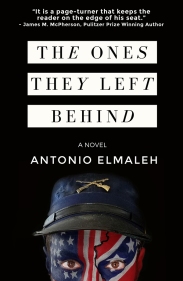
I received a letter recently from a woman who had read my novel, THE ONES THEY LEFT BEHIND. In it, she thanked me for writing the book, in part because it spurred her to go back into her family history. This in itself was startling, as she is well into her 80s.
On her stairs, there is a photograph of an old man with white hair and whiskers standing on a porch with other grizzled old men. She knew little about the picture, but after reading my book she went back into whatever old letters, diaries and photos she could find. She shared this story.
Her great-grandmother was dusting out a rug on her porch in Lewisburg, PA. It was June of 1865. The woman heard a whistle announcing the arrival of a train. She could see the station and watched the train pull in. At first, no one got off. Finally a solitary soldier almost toppled onto the ground, then unsteadily raised himself up. He was clearly very drunk. Her great grandmother watched the soldier stagger down the street, but curiously didn’t pay him any mind. She had seen this many times before – soldiers returning home, either from leave during the war, or after they were mustered out once the war was over. They were often completely inebriated. She went back inside.
As she worked, she thought about the soldier and realized that the right thing to do was to offer him some water and possibly directions so he could find his way home in his drunken stupor. She went back outside with a glass of water. There before her in the street was the soldier standing in the sunlight. As she approached, she recognized her son.
That boy was the old man with the grizzled white beard and hair surrounded by his former soldiers, his band of brothers, looking out from a faded black-and-white photograph on her stairs.
This scene could just as easily have been played out in Clarksville, TN, Roswell, GA or Centerville, IA. And it did, in ten thousand other towns across America after Our War.
In my novel, THE ONES THEY LEFT BEHIND, there is a moment when the three travelers Harriman Hickenlooper, Lucinda McWhorter and Rufus Dewes stand before Abraham Lincoln’s crypt in Springfield, Illinois.
“I still can’t believe they killed him,” Rufus said.
“I can,” Harriman answered.
“Why? I thought you loved Mr. Lincoln.”
“I do. Love cuts both ways.”
“I don’t understand.”
Harriman sat down on a bench near the crypt, staring at the other gravestones, listening to the sound of a caretaker’s broom sweeping on stone. “It was Easter time. The fourth spring of the war. We’d beaten Joe Johnston’s army at Bentonville and were chasing what was left of it around North Carolina…We knew it was over. Everyone felt this immense thrill…We entered this town, and like most towns, there was no one in sight when we arrived. We were relaxed, almost kidding around. Bugler sounded assembly and we formed up in the town square. Ridley read an announcement…President Lincoln had been shot and died on Good Friday. We couldn’t believe it…The boys were ready to torch the town right then. Ridley reminded us we had strict orders to maintain security and act like soldiers. He said General Sherman had ordered black bunting hung from every window in every town we came through…Lucas and me got to this one house and knocked on the door…At first, no one answered. I knew someone was home, I’d seen a face peer out from a window curtain. ‘Open the goddamned door, you dirty Rebel’. I was about to beat the door down when it swung open. The woman standing there didn’t look right.”
“What do you mean, din’t look right?” Lucinda asked.
“I mean, I could see she was young by how smooth and unwrinkled her skin was. But her hair was white, white as snow. She wore a black dress, like she’d been to a funeral…Lucas told her we had orders to hang this stuff from her balcony as a sign of mourning for our president.
“And she answered, ‘he is not my president.’
“I swear to God, I almost shot her right then. I told her we had orders to burn her house down if she didn’t comply.”
“This is an outrage,’ she said.
“Killing President Lincoln just when this war’s done, that’s the outrage!” I shouted.
“Her face turned the color of her hair. She grabbed my sleeve. ‘I have given a husband and a brother for our cause. Please, I beseech you. I will do as you order, but please leave my house. Leave me my dignity.’
I realized she had not heard the news yet. ‘Hurry it up. We’ll be watching.’
“The woman walked out onto her balcony overlooking the street. Some of the boys were yelling at her and catcalling. The woman ignored them and carefully wrapped the bunting around the iron railing, then wrapped it around her neck. She mounted the railing, looked me in the eye, and without missing a beat, jumped off. Just. Like. That…’
“Lord have mercy”, the caretaker mumbled. He crossed himself and moved off.
Lucinda held her hand over her mouth.
Rufus wrote in his diary.
“She loved her cause as deeply as I loved mine,” Harriman said. “And she gave her life for it, even after it was lost. It cuts both ways.”
It is arguably as great a tragedy as the catastrophic war that preceded it that Lincoln never lived to put into actions the great healing and reconciliation he so longed for, so eloquently articulated in his Second Inaugural Address barely a month before his death, and that the country needed so desperately. “…Both read the same Bible and pray to the same God, and each invokes His aid against the other. It may seem strange that any men should dare to ask a just God’s assistance in wringing their bread from the sweat of other men’s faces, but let us judge not, that we be not judged…”
See if his closing words do not powerfully resonate now. “With malice toward none, with charity for all, with firmness in the right as God gives us to see the right, let us strive on to finish the work we are in, to bind up the nation’s wounds, to care for him who shall have borne the battle and for his widow and his orphan, to do all which may achieve and cherish a just and lasting peace among ourselves and with all nations.”
In other words, to build A House United.
To my hero, Abraham Lincoln. I am forever grateful for your service to our country. By your words and your deeds, you showed us what it means to live by the better angels of our nature.
May we be blessed to have a leader like you again some day.